You scaled the company. The volume doubled, then doubled again. More PSPs, more markets, more settlement files. This benchmark scores your high-volume accounting across six factors and shows you where control breaks first, before the funding round, the board meeting, or the auditor finds it.
No data exports. Your answers stay private. No sales call. Built by a 13-year Deloitte Registered Accountant.






High-volume finance teams almost always overrate their own maturity. [Add a real stat here, e.g. 7 in 10 score below Level 3.] The only way to know your number is to measure it. Twelve minutes, scored against your peers.
Get your score →It fails the week before the funding round. The night before the board deck. The morning the auditor asks you to prove completeness, and the answer is a person, not a system.
At low volume, your ERP is the system of truth. At high volume it becomes the system of contamination. Errors enter at the point of booking and compound silently until close, or audit, drags them into the light.
A 2% variance nobody can explain during due diligence isn't a correction. It's a discount on your valuation.
Truth isn't added at close.
It's established upstream.
The principle behind the Real Financial Control Framework
You've said at least one of these. Read the second line of each. That's what's actually happening underneath, while volume keeps climbing.
“We'll true it up at close.”
WHAT'S REALLY HAPPENINGCorrection has quietly replaced prevention. The error spreads before anyone sees it, and close becomes a discovery exercise instead of a confirmation.
“Doubling volume just means doubling the team.”
WHAT'S REALLY HAPPENINGThe process scales on people, not infrastructure. Headcount becomes your growth ceiling, and your margin story falls apart in the board deck.
“That gap? That's the PSP's problem.”
WHAT'S REALLY HAPPENINGEnd-to-end ownership stops at the system boundary. Refunds and chargebacks break the chain, and reconciliation silently stops tying out.
“Only the auditor really needs full traceability.”
WHAT'S REALLY HAPPENINGControl is reactive, once a year, by hand. The proof lives in one person's head. A continuity risk wearing an audit costume.
The volume isn't slowing down. Hiring your way out just moves the ceiling up a floor. Real financial control is structural, established before the ledger, or it isn't control at all.

The benchmark scores you on all six. Each builds on the last: fix a later factor without the earlier ones and you've built fragile progress on a cracked foundation.
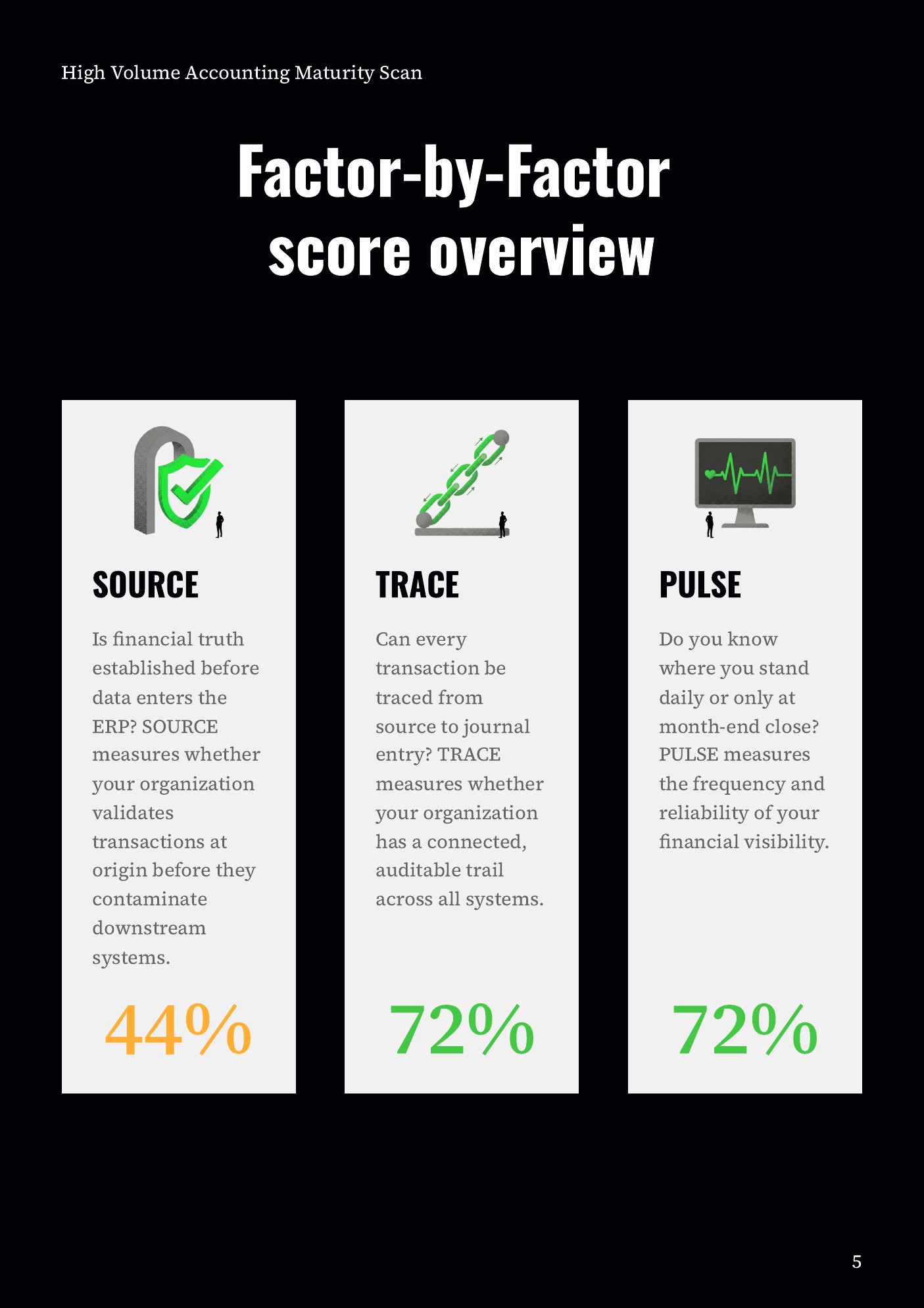
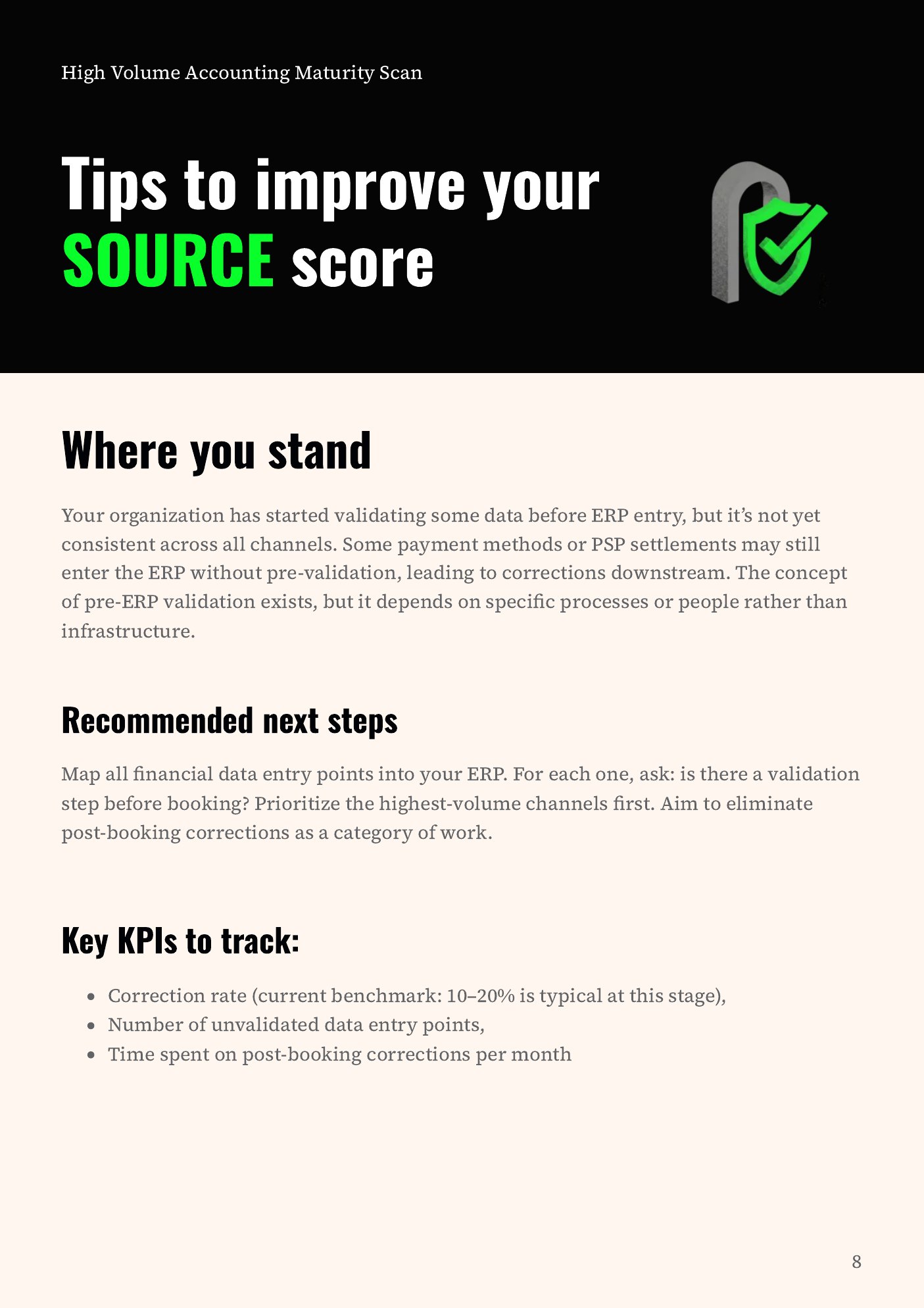
Is truth established before data enters the ERP?
SOURCE measures whether you validate transactions at origin, before they contaminate everything downstream.
Can every transaction be traced source to journal?
TRACE measures whether you have one connected, auditable trail across all systems, not tribal knowledge.
Do you know where you stand daily, or only at close?
PULSE measures the frequency and reliability of your financial visibility. Steering, not month-end guessing.
Does the system explain why differences exist?
ROOT measures how much variance analysis is automated, versus people rediscovering the same issue every month.
Can you prove completeness at any moment?
PROOF measures whether audit readiness is structural, a byproduct of daily operations, or an annual fire drill.
If volume doubled tomorrow, would it hold or break?
SCALE measures whether infrastructure absorbs growth without proportional headcount. Scale without heroics.
SOURCE → TRACE → PULSE → ROOT → PROOF → SCALE. A chain is only as strong as the factor that breaks first.

Both feel like control from the inside. Only one survives 2× volume and a sharp auditor.
“We thought we were audit-ready. The scan found two PSP flows that never tied out. We fixed them before our raise, not during it.”
[Name, CFO] · [Company] · replace with a real, approved quote
From four FTE on reconciliation to one, without slowing the close.
Proof-of-concept to working trace in days, not a quarter-long project.
From waiting a month for reporting to live financial visibility, mid-month.

Real control doesn't mean checking more. It means building a system that doesn't need to be checked.Peter EngelFounder & CEO, Actuals · 13 years as a Public Registered Accountant & Auditor at Deloitte
Actuals builds the pre-accounting control layer for high-volume finance teams: a single source of truth across order, payment and settlement data, before it ever reaches the ledger. Because accounting truth doesn't originate in the ERP. It originates before.
Answer focused questions about how your high-volume finance setup actually works today. No prep, no data exports.
Receive your personalised benchmark in your inbox: level, six-factor profile and prioritised next steps.
Optional, no-pitch conversation about your Real Financial Control roadmap and where the chain breaks first.